The room that teaches you how to breathe
A herringbone floor, a mandala mosaic wall, river stone cairns, and nothing else that doesn't belong — designing a conservatory for mindfulness means designing a room that mirrors the mind you're trying to cultivate.
The mind takes the shape of the room it's in. Put yourself in a cluttered space and your thoughts will clutter. Put yourself in a room that is loud with color and pattern and your attention will scatter. This is not philosophy — it is simple neurology. The visual field is never neutral. It is always doing something to you.
A room designed for mindfulness and meditation has one job: to make it easier to be still. Not to force stillness — that is not how it works — but to remove the obstacles to it. Clutter is an obstacle. Visual noise is an obstacle. Objects that demand attention are obstacles. Strip them away and what remains is space, and space is where the breath goes.
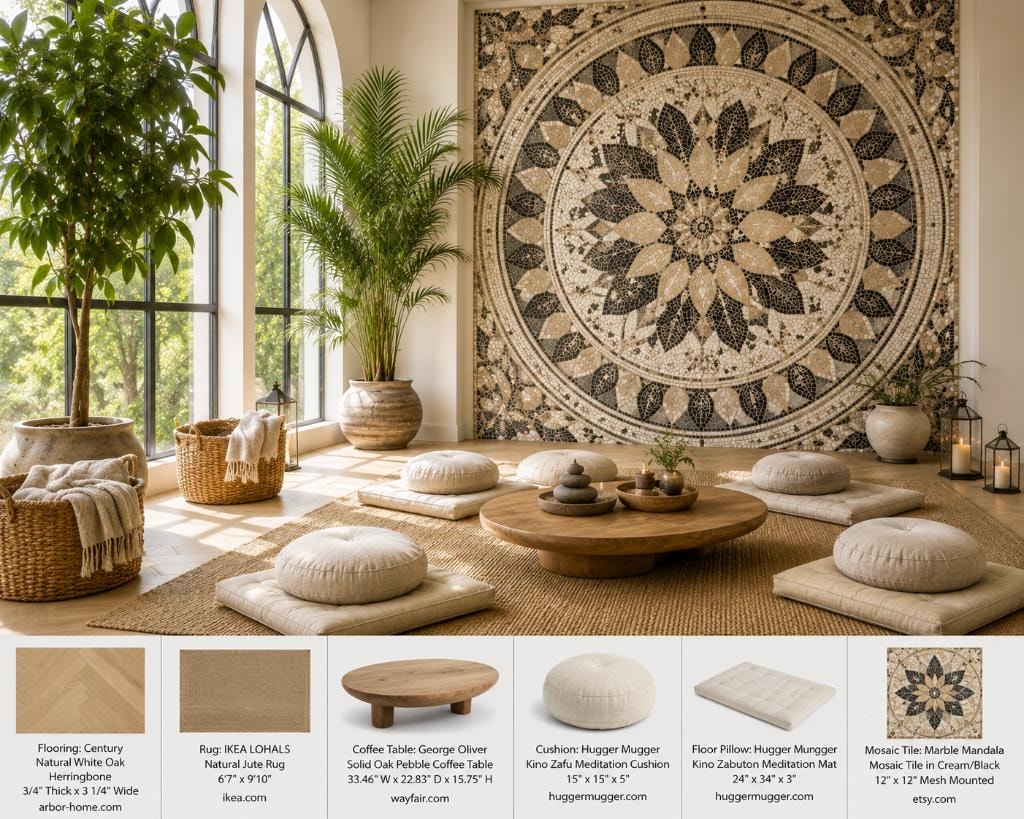
The floor is the foundation of everything. Wide-plank light wood in a herringbone pattern — pale blonde, barely stained — gives the room its geometry without imposing it. The herringbone is a pattern that rewards stillness: the more quietly you look at it, the more it reveals. A natural jute rug in undyed hemp tones anchors the sitting area, soft underfoot and honest in its material. Nothing synthetic. Nothing that pretends to be something it isn't.
One wall is given entirely to a floor-to-ceiling tile mandala mosaic. This is the room's single act of visual complexity, and it earns its place precisely because it is the only one. A mandala is not decoration — it is a meditation object, a geometric representation of the universe's order, designed to be looked at with the same quality of attention you bring to the breath. In whites, creams, and warm greys, it reads as almost architectural from a distance and reveals its intricacy only when you sit with it.
The windows are the room's lungs. Large, unobstructed, covered only with sheer linen panels that diffuse the light into something soft and directionless — the kind of light that has no hard edges, that fills the room evenly without casting dramatic shadows. On a clear morning, the room glows. On an overcast day, it is still and grey in the most peaceful way. The light is never wrong here.
Two plants. Not a collection, not a jungle — two plants, chosen for their sculptural quality and placed with the same intention you'd place a piece of furniture. A fiddle leaf fig in the corner near the window, its broad leaves catching the light. A bird of paradise beside it, taller and more architectural, its leaves fanning outward like an open hand. They are the room's only color, and they are enough. Green in a room this spare is not decoration. It is oxygen.
The sitting area is low to the ground — intentionally, deliberately low. A bamboo platform table at eighteen inches, a zafu meditation cushion in natural cotton, an oversized linen floor pillow. The act of lowering yourself to the floor is itself a transition, a physical signal to the nervous system that something is changing. You are not sitting at a desk. You are not on a sofa. You are on the ground, which is where the body has always known how to rest.
On the low table: river stone cairns. Three or four smooth stones stacked in careful balance, the kind you find beside a mountain stream. They are the room's only decorative object, and they are not decorative — they are functional. A cairn is a practice. It requires patience, attention, and a willingness to start over when the stack falls. It is, in miniature, what the room is asking of you.
The textiles are all natural fiber — cotton, linen, jute. No synthetics, nothing that holds static or feels slick under bare skin. The colors are white, cream, natural linen, light grey. Not because color is wrong but because in a room this intentional, color would be a decision, and decisions are what you come here to set down. The absence of color is not emptiness. It is permission.
There is a particular quality of silence that a room like this produces — not the silence of absence but the silence of sufficiency. Everything that is here belongs here. Nothing is missing. Nothing is extra. You sit in it and feel, perhaps for the first time in a long day, that you do not need to do anything at all. That is the room working. That is the design doing its job.
Shop the room
Natural White Oak Herringbone Flooring
Century / Arbor Home
3/4" thick × 3 1/4" wide — warm blonde tone, classic herringbone pattern
LOHALS Natural Jute Rug
IKEA
6'7" × 9'10" — flatweave, undyed natural jute
Solid Oak Pebble Coffee Table
George Oliver / Wayfair
33.46"W × 22.83"D × 15.75"H — low profile, perfect for floor seating
Kino Zafu Meditation Cushion
Hugger Mugger
15" × 15" × 5" — natural cotton, buckwheat fill
Kino Zabuton Meditation Mat
Hugger Mugger
24" × 34" × 3" — floor pillow base for cushion or solo use
Marble Mandala Mosaic Tile in Cream/Black
Etsy
12" × 12" mesh mounted — natural stone, geometric sacred geometry